
Self-supervised learning, Pt. 1
gpu_info = !nvidia-smi
gpu_info = '\n'.join(gpu_info)
if gpu_info.find('failed') >= 0:
  print('Not connected to a GPU')
else:
  print(gpu_info)
Tue Aug 31 19:07:04 2021
+-----------------------------------------------------------------------------+
| NVIDIA-SMI 470.57.02    Driver Version: 460.32.03    CUDA Version: 11.2     |
|-------------------------------+----------------------+----------------------+
| GPU  Name        Persistence-M| Bus-Id        Disp.A | Volatile Uncorr. ECC |
| Fan  Temp  Perf  Pwr:Usage/Cap|         Memory-Usage | GPU-Util  Compute M. |
|                               |                      |               MIG M. |
|===============================+======================+======================|
|   0  Tesla T4            Off  | 00000000:00:04.0 Off |                    0 |
| N/A   48C    P8    10W /  70W |      0MiB / 15109MiB |      0%      Default |
|                               |                      |                  N/A |
+-------------------------------+----------------------+----------------------+

+-----------------------------------------------------------------------------+
| Processes:                                                                  |
|  GPU   GI   CI        PID   Type   Process name                  GPU Memory |
|        ID   ID                                                   Usage      |
|=============================================================================|
|  No running processes found                                                 |
+-----------------------------------------------------------------------------+
%%capture
!pip install pytorch_lightning
from torchvision.models import resnet18
import torch
from torch import nn
import torch.nn.functional as F

from torchvision import transforms
import torchvision.transforms.functional as TF

from torchvision.datasets import FashionMNIST
from torch.utils.data import ConcatDataset, DataLoader

import pytorch_lightning as pl
import torchmetrics

import matplotlib.pyplot as plt
%matplotlib inline
class AngleImageTransform:
    """Rotate by given angle and apply label."""

    def __init__(self, angle):
        self.angle = angle
        assert (angle%angles[1] == 0)

    def __call__(self, x):
        return TF.rotate(x, self.angle)

class AngleTargetTransform:
    """Paired with AngleImageTransform to assign self-supervised labels."""

    def __init__(self, angle):
        self.angle = angle
        assert (angle%angles[1] == 0)

    def __call__(self, x):
        return self.angle//angles[1] #0->0, 90->1, 180->2, 270->3

# generate 4 data sets, at each of the different x90 angles
angles = [0, 90, 180, 270]
# potentially add gaussian blur/noise, or use learned augmentations
data_transform = transforms.Compose([
                                    transforms.ToTensor(),
                                    transforms.RandomResizedCrop(28, scale=(0.8, 1.0)),
                                    transforms.GaussianBlur(3),
                                    transforms.RandomHorizontalFlip(p=0.5),
                                    transforms.Normalize((0.5), (0.5))
                                    ])
image_transforms = [transforms.Compose([
                                       data_transform,
                                       AngleImageTransform(i)
                                       ])
                    for i in angles
                   ]
label_transforms = [AngleTargetTransform(i) for i in angles]

test_transform = transforms.Compose([
                                     transforms.ToTensor(),
                                     transforms.Normalize((0.5), (0.5))
])
from torch.utils.data import Subset
train_len = 60000
each_train_len = train_len//len(angles)
val_len = 10000
each_val_len = val_len//len(angles)
# shuffle indices
train_indices = torch.randperm(train_len)
val_indices = torch.randperm(val_len)

bs = 128

train_ds_angles = [0] * len(angles)
for i in range(len(angles)):
  # shift angles and labels
  train_ds_angles[i] = FashionMNIST("f-mnist",
                            train=True,
                            transform=image_transforms[i],
                            target_transform=label_transforms[i],
                            download=True)
  # subset 1/4
  train_ds_angles[i] = Subset(train_ds_angles[i], train_indices[i*each_train_len:i*each_train_len+each_train_len])
train_ds = ConcatDataset(train_ds_angles)
train_dl = DataLoader(train_ds, batch_size=bs, shuffle=True)

val_ds_angles = [0] * len(angles)
for i in range(len(angles)):
  val_ds_angles[i] = FashionMNIST("f-mnist",
                            train=False,
                            transform=image_transforms[i],
                            target_transform=label_transforms[i],
                            download=True)
  # subset 1/4
  val_ds_angles[i] = Subset(val_ds_angles[i], val_indices[i*each_val_len:i*each_val_len+each_val_len])
val_ds = ConcatDataset(val_ds_angles)
val_dl = DataLoader(val_ds, batch_size=bs)

train_ds_supervised = FashionMNIST("f-mnist",
                        train=True,
                        transform=data_transform,
                        download=True)
train_dl_supervised = DataLoader(train_ds_supervised, batch_size=bs, shuffle=True)

test_ds = FashionMNIST("f-mnist",
                        train=False,
                        transform=test_transform,
                        download=True)
test_dl = DataLoader(test_ds, batch_size=bs)
Downloading http://fashion-mnist.s3-website.eu-central-1.amazonaws.com/train-images-idx3-ubyte.gz
Downloading http://fashion-mnist.s3-website.eu-central-1.amazonaws.com/train-images-idx3-ubyte.gz to f-mnist/FashionMNIST/raw/train-images-idx3-ubyte.gz


  0%|          | 0/26421880 [00:00<?, ?it/s]


Extracting f-mnist/FashionMNIST/raw/train-images-idx3-ubyte.gz to f-mnist/FashionMNIST/raw

Downloading http://fashion-mnist.s3-website.eu-central-1.amazonaws.com/train-labels-idx1-ubyte.gz
Downloading http://fashion-mnist.s3-website.eu-central-1.amazonaws.com/train-labels-idx1-ubyte.gz to f-mnist/FashionMNIST/raw/train-labels-idx1-ubyte.gz


  0%|          | 0/29515 [00:00<?, ?it/s]


Extracting f-mnist/FashionMNIST/raw/train-labels-idx1-ubyte.gz to f-mnist/FashionMNIST/raw

Downloading http://fashion-mnist.s3-website.eu-central-1.amazonaws.com/t10k-images-idx3-ubyte.gz
Downloading http://fashion-mnist.s3-website.eu-central-1.amazonaws.com/t10k-images-idx3-ubyte.gz to f-mnist/FashionMNIST/raw/t10k-images-idx3-ubyte.gz


  0%|          | 0/4422102 [00:00<?, ?it/s]


Extracting f-mnist/FashionMNIST/raw/t10k-images-idx3-ubyte.gz to f-mnist/FashionMNIST/raw

Downloading http://fashion-mnist.s3-website.eu-central-1.amazonaws.com/t10k-labels-idx1-ubyte.gz
Downloading http://fashion-mnist.s3-website.eu-central-1.amazonaws.com/t10k-labels-idx1-ubyte.gz to f-mnist/FashionMNIST/raw/t10k-labels-idx1-ubyte.gz


  0%|          | 0/5148 [00:00<?, ?it/s]


Extracting f-mnist/FashionMNIST/raw/t10k-labels-idx1-ubyte.gz to f-mnist/FashionMNIST/raw


/usr/local/lib/python3.7/dist-packages/torchvision/datasets/mnist.py:498: UserWarning: The given NumPy array is not writeable, and PyTorch does not support non-writeable tensors. This means you can write to the underlying (supposedly non-writeable) NumPy array using the tensor. You may want to copy the array to protect its data or make it writeable before converting it to a tensor. This type of warning will be suppressed for the rest of this program. (Triggered internally at  /pytorch/torch/csrc/utils/tensor_numpy.cpp:180.)
  return torch.from_numpy(parsed.astype(m[2], copy=False)).view(*s)
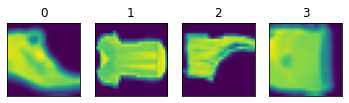
c = 0
for j in range(len(angles)):
  for x, y in train_ds_angles[j]:
    ax = plt.subplot(1, len(angles),j+1)
    ax.imshow(x[0,:,:])
    ax.set(yticklabels=[])  # remove the tick labels
    ax.set(xticklabels=[])  # remove the tick labels
    plt.tick_params(left=False, bottom=False)
    plt.title(y)
    break
plt.show()
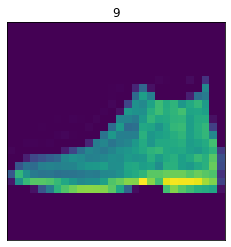
for x, y in test_ds:
    ax = plt.subplot(1,1,1)
    ax.imshow(x[0,:,:])
    ax.set(yticklabels=[])  # remove the tick labels
    ax.set(xticklabels=[])  # remove the tick labels
    plt.tick_params(left=False, bottom=False)
    plt.title(y)
    break
plt.show()
class ResNetforFMNIST(pl.LightningModule):
  def __init__(self):
    super().__init__()
    self.model = resnet18(num_classes=len(angles)) # proxy task has #classes=#angles
    self.model.conv1 = nn.Conv2d(1, 64, kernel_size=(7,7), stride=(2,2), padding=(3,3), bias=False)
    # fmnist has 1 channel
    self.train_accuracy = torchmetrics.Accuracy()
    self.val_accuracy = torchmetrics.Accuracy()

  def forward(self, x):
    return self.model(x)

  def training_step(self, batch, batch_idx):
    x, y = batch
    logits = self(x)
    loss = F.cross_entropy(logits, y)
    self.log('train_loss', loss)
    self.log('train_accuracy', self.train_accuracy(logits, y))
    return loss

  def validation_step(self, batch, batch_idx):
    x, y = batch
    logits = self(x)
    loss = F.cross_entropy(logits, y)
    self.log('val_loss', loss)
    self.log('val_accuracy', self.val_accuracy(logits, y))
    return loss

  def configure_optimizers(self):
    return torch.optim.Adam(self.parameters()) # scheduler = for noobs , lr=3e-4
%load_ext tensorboard
%tensorboard --logdir lightning_logs
<IPython.core.display.Javascript object>
# model = ResNetforFMNIST()
# trainer = pl.Trainer(
#     gpus=1,
#     max_epochs=50
# )
# trainer.fit(model, train_dl, val_dl)
# trainer.save_checkpoint("proxy.ckpt")
finetune_dss = {}
finetune_dls = {}
for amount in [600, 3000, 6000, 9000, 12000, 18000, 24000, 30000]:
  indices = torch.randint(len(train_ds_supervised), (amount,)) # random shuffle (with replacement) of 1%
  finetune_dss[str(amount//600)] = Subset(train_ds_supervised, indices)
  finetune_dls[str(amount//600)] = DataLoader(finetune_dss[str(amount//600)], batch_size=64, shuffle=False)
proxy = ResNetforFMNIST.load_from_checkpoint(checkpoint_path='proxy.ckpt')
proxy
ResNetforFMNIST(
  (model): ResNet(
    (conv1): Conv2d(1, 64, kernel_size=(7, 7), stride=(2, 2), padding=(3, 3), bias=False)
    (bn1): BatchNorm2d(64, eps=1e-05, momentum=0.1, affine=True, track_running_stats=True)
    (relu): ReLU(inplace=True)
    (maxpool): MaxPool2d(kernel_size=3, stride=2, padding=1, dilation=1, ceil_mode=False)
    (layer1): Sequential(
      (0): BasicBlock(
        (conv1): Conv2d(64, 64, kernel_size=(3, 3), stride=(1, 1), padding=(1, 1), bias=False)
        (bn1): BatchNorm2d(64, eps=1e-05, momentum=0.1, affine=True, track_running_stats=True)
        (relu): ReLU(inplace=True)
        (conv2): Conv2d(64, 64, kernel_size=(3, 3), stride=(1, 1), padding=(1, 1), bias=False)
        (bn2): BatchNorm2d(64, eps=1e-05, momentum=0.1, affine=True, track_running_stats=True)
      )
      (1): BasicBlock(
        (conv1): Conv2d(64, 64, kernel_size=(3, 3), stride=(1, 1), padding=(1, 1), bias=False)
        (bn1): BatchNorm2d(64, eps=1e-05, momentum=0.1, affine=True, track_running_stats=True)
        (relu): ReLU(inplace=True)
        (conv2): Conv2d(64, 64, kernel_size=(3, 3), stride=(1, 1), padding=(1, 1), bias=False)
        (bn2): BatchNorm2d(64, eps=1e-05, momentum=0.1, affine=True, track_running_stats=True)
      )
    )
    (layer2): Sequential(
      (0): BasicBlock(
        (conv1): Conv2d(64, 128, kernel_size=(3, 3), stride=(2, 2), padding=(1, 1), bias=False)
        (bn1): BatchNorm2d(128, eps=1e-05, momentum=0.1, affine=True, track_running_stats=True)
        (relu): ReLU(inplace=True)
        (conv2): Conv2d(128, 128, kernel_size=(3, 3), stride=(1, 1), padding=(1, 1), bias=False)
        (bn2): BatchNorm2d(128, eps=1e-05, momentum=0.1, affine=True, track_running_stats=True)
        (downsample): Sequential(
          (0): Conv2d(64, 128, kernel_size=(1, 1), stride=(2, 2), bias=False)
          (1): BatchNorm2d(128, eps=1e-05, momentum=0.1, affine=True, track_running_stats=True)
        )
      )
      (1): BasicBlock(
        (conv1): Conv2d(128, 128, kernel_size=(3, 3), stride=(1, 1), padding=(1, 1), bias=False)
        (bn1): BatchNorm2d(128, eps=1e-05, momentum=0.1, affine=True, track_running_stats=True)
        (relu): ReLU(inplace=True)
        (conv2): Conv2d(128, 128, kernel_size=(3, 3), stride=(1, 1), padding=(1, 1), bias=False)
        (bn2): BatchNorm2d(128, eps=1e-05, momentum=0.1, affine=True, track_running_stats=True)
      )
    )
    (layer3): Sequential(
      (0): BasicBlock(
        (conv1): Conv2d(128, 256, kernel_size=(3, 3), stride=(2, 2), padding=(1, 1), bias=False)
        (bn1): BatchNorm2d(256, eps=1e-05, momentum=0.1, affine=True, track_running_stats=True)
        (relu): ReLU(inplace=True)
        (conv2): Conv2d(256, 256, kernel_size=(3, 3), stride=(1, 1), padding=(1, 1), bias=False)
        (bn2): BatchNorm2d(256, eps=1e-05, momentum=0.1, affine=True, track_running_stats=True)
        (downsample): Sequential(
          (0): Conv2d(128, 256, kernel_size=(1, 1), stride=(2, 2), bias=False)
          (1): BatchNorm2d(256, eps=1e-05, momentum=0.1, affine=True, track_running_stats=True)
        )
      )
      (1): BasicBlock(
        (conv1): Conv2d(256, 256, kernel_size=(3, 3), stride=(1, 1), padding=(1, 1), bias=False)
        (bn1): BatchNorm2d(256, eps=1e-05, momentum=0.1, affine=True, track_running_stats=True)
        (relu): ReLU(inplace=True)
        (conv2): Conv2d(256, 256, kernel_size=(3, 3), stride=(1, 1), padding=(1, 1), bias=False)
        (bn2): BatchNorm2d(256, eps=1e-05, momentum=0.1, affine=True, track_running_stats=True)
      )
    )
    (layer4): Sequential(
      (0): BasicBlock(
        (conv1): Conv2d(256, 512, kernel_size=(3, 3), stride=(2, 2), padding=(1, 1), bias=False)
        (bn1): BatchNorm2d(512, eps=1e-05, momentum=0.1, affine=True, track_running_stats=True)
        (relu): ReLU(inplace=True)
        (conv2): Conv2d(512, 512, kernel_size=(3, 3), stride=(1, 1), padding=(1, 1), bias=False)
        (bn2): BatchNorm2d(512, eps=1e-05, momentum=0.1, affine=True, track_running_stats=True)
        (downsample): Sequential(
          (0): Conv2d(256, 512, kernel_size=(1, 1), stride=(2, 2), bias=False)
          (1): BatchNorm2d(512, eps=1e-05, momentum=0.1, affine=True, track_running_stats=True)
        )
      )
      (1): BasicBlock(
        (conv1): Conv2d(512, 512, kernel_size=(3, 3), stride=(1, 1), padding=(1, 1), bias=False)
        (bn1): BatchNorm2d(512, eps=1e-05, momentum=0.1, affine=True, track_running_stats=True)
        (relu): ReLU(inplace=True)
        (conv2): Conv2d(512, 512, kernel_size=(3, 3), stride=(1, 1), padding=(1, 1), bias=False)
        (bn2): BatchNorm2d(512, eps=1e-05, momentum=0.1, affine=True, track_running_stats=True)
      )
    )
    (avgpool): AdaptiveAvgPool2d(output_size=(1, 1))
    (fc): Linear(in_features=512, out_features=4, bias=True)
  )
  (train_accuracy): Accuracy()
  (val_accuracy): Accuracy()
)
# proxy = ResNetforFMNIST.load_from_checkpoint(checkpoint_path='proxy.ckpt')
for param in proxy.parameters():
    proxy.requires_grad = False
# proxy = ResNetforFMNIST()
# proxy.model.fc = nn.Sequential(
#     nn.Linear(in_features=512, out_features=512, bias=True),
#     nn.ReLU(),
#     nn.Linear(in_features=512, out_features=10, bias=True)
# )
proxy.model.fc = nn.Linear(in_features=512, out_features=10, bias=True) # change to 10 for real task
trainer = pl.Trainer(
    gpus=1,
    max_epochs=250,
    log_every_n_steps=10
)
trainer.fit(proxy, finetune_dls['5'], test_dl)
GPU available: True, used: True
TPU available: False, using: 0 TPU cores
IPU available: False, using: 0 IPUs
LOCAL_RANK: 0 - CUDA_VISIBLE_DEVICES: [0]

  | Name           | Type     | Params
--------------------------------------------
0 | model          | ResNet   | 11.2 M
1 | train_accuracy | Accuracy | 0
2 | val_accuracy   | Accuracy | 0
--------------------------------------------
11.2 M    Trainable params
0         Non-trainable params
11.2 M    Total params
44.701    Total estimated model params size (MB)


Validation sanity check: 0it [00:00, ?it/s]


/usr/local/lib/python3.7/dist-packages/torch/nn/functional.py:718: UserWarning: Named tensors and all their associated APIs are an experimental feature and subject to change. Please do not use them for anything important until they are released as stable. (Triggered internally at  /pytorch/c10/core/TensorImpl.h:1156.)
  return torch.max_pool2d(input, kernel_size, stride, padding, dilation, ceil_mode)
# proxy = ResNetforFMNIST.load_from_checkpoint(checkpoint_path='proxy.ckpt')
# for param in proxy.parameters():
#     proxy.requires_grad = False
proxy = ResNetforFMNIST()
proxy.model.fc = nn.Sequential(
    nn.Linear(in_features=512, out_features=512, bias=True),
    nn.ReLU(),
    nn.Linear(in_features=512, out_features=10, bias=True)
)
# proxy.model.fc = nn.Linear(in_features=512, out_features=10, bias=True) # change to 10 for real task

trainer = pl.Trainer(
    gpus=1,
    max_epochs=100,
    log_every_n_steps=10
)
trainer.fit(proxy, finetune_dls['5'], test_dl)
GPU available: True, used: True
TPU available: False, using: 0 TPU cores
IPU available: False, using: 0 IPUs
LOCAL_RANK: 0 - CUDA_VISIBLE_DEVICES: [0]

  | Name           | Type     | Params
--------------------------------------------
0 | model          | ResNet   | 11.4 M
1 | train_accuracy | Accuracy | 0
2 | val_accuracy   | Accuracy | 0
--------------------------------------------
11.4 M    Trainable params
0         Non-trainable params
11.4 M    Total params
45.752    Total estimated model params size (MB)
# proxy = ResNetforFMNIST.load_from_checkpoint(checkpoint_path='proxy.ckpt')
# for param in proxy.parameters():
#     proxy.requires_grad = False
proxy = ResNetforFMNIST()
proxy.model.fc = nn.Sequential(
    nn.Linear(in_features=512, out_features=512, bias=True),
    nn.ReLU(),
    nn.Linear(in_features=512, out_features=10, bias=True)
)
# proxy.model.fc = nn.Linear(in_features=512, out_features=10, bias=True) # change to 10 for real task

trainer = pl.Trainer(
    gpus=1,
    max_epochs=50,
    log_every_n_steps=10
)
trainer.fit(proxy, finetune_dls['10'], test_dl)
GPU available: True, used: True
TPU available: False, using: 0 TPU cores
IPU available: False, using: 0 IPUs
LOCAL_RANK: 0 - CUDA_VISIBLE_DEVICES: [0]

  | Name           | Type     | Params
--------------------------------------------
0 | model          | ResNet   | 11.4 M
1 | train_accuracy | Accuracy | 0
2 | val_accuracy   | Accuracy | 0
--------------------------------------------
11.4 M    Trainable params
0         Non-trainable params
11.4 M    Total params
45.752    Total estimated model params size (MB)
Leave a comment